
Lancaster, CA
Water Damage Restoration Cost in Lancaster, CA: A Plain Pricing Guide
Most water damage jobs in the U.S. cost between about $1,200 and $5,000, according to Fixr's 2025 cost guide. We found no public price data for Lancaster itself. So this guide shows sourced national ranges, real bills people have posted, and how to read an estimate line by line.
- Free callYou pay this site nothing
- Line open 24/7Calls answered day and night
- No obligationGet an estimate, then decide
- Lancaster, CAZIP 93534 · 93535 · 93536
- License check guideHow to look up a CSLB license
Free referral service, not a contractor. You are connected with an independent restoration company. How this works
How much does water damage restoration cost?
Most jobs fall between about $1,200 and $5,000, with an average near $3,000, according to Fixr's national cost guide (January 2025). Fixr also reports jobs as low as $350 and as high as $50,000.
Other national guides land in the same area. Their methods differ, so their averages differ too.
| Source | What it reports | Date |
|---|---|---|
| Fixr cost guide | Typical $1,200–$5,000; average about $3,000; low $350; high $50,000 | Jan 31, 2025 |
| LawnStarter cost guide | About $3.15–$7.40 per square foot; average about $3,250; typical $1,270–$5,376 | 2026 |
| Servpro resource page | National average $3,865; most jobs $450–$16,000 | Sep 14, 2026 |
| Google AI Overview, Lancaster search | About $1,200–$5,000 | Seen Oct 11, 2026 |
The last row is an AI-written summary in Google's results, not a price study. It credited a restoration company's web page. Its range matches Fixr's national figure.
All of these are national numbers. We found no public source of Lancaster-specific prices. Treat them as a starting point, not a quote.
What does it cost per square foot in Lancaster, CA?
No independent per-square-foot data for Lancaster was found. The only local figures are one Lancaster company's own published tiers. Those are that company's marketing claim, not a survey.
Scientific Restoration Specialists, a Lancaster company, published these tiers for 2025 in a January 2026 press release:
| Damage level | Price per square foot (company's own claim) |
|---|---|
| Minor | $3.50–$5.75 |
| Moderate | $4.75–$7.50 |
| Severe | $7.25–$12.00 |
We have not checked these tiers against real invoices. The company you're connected with through this site may be a different business. It sets its own price.
For comparison, LawnStarter's 2026 national guide puts restoration at about $3.15 to $7.40 per square foot. Per-square-foot pricing only covers the wet area, not the whole house. It also tends to leave out extras like contents handling or rebuild work.
Want a real number for your home? Call (661) 555-0123 and ask the company for a written estimate.
Why is water damage restoration so expensive?
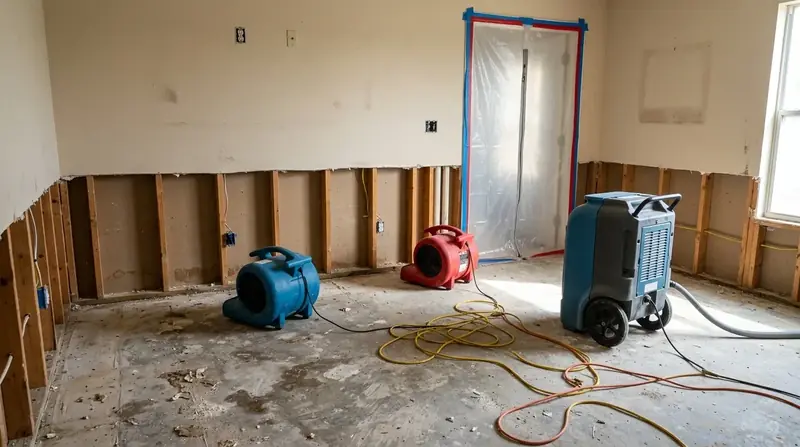
Most of the cost is labor, drying equipment that runs for days, and wet materials that must be removed and replaced. Dirty water and hidden moisture add more.
What pushes the price up or down:
- How far the water spread and how long it sat before drying started.
- The water category. Sewage and floodwater cost more to handle than clean water.
- What got wet: carpet and pad, hardwood or laminate, drywall, insulation, cabinets.
- Equipment days. Drying equipment is commonly billed by the day.
- Contents pack-out. This means moving furniture and belongings out to be cleaned or stored. Storage adds a monthly cost.
- Rebuild work on top of drying, like new drywall, paint and flooring.
How the water category changes the bill
The IICRC S500 standard sorts water into three categories. IICRC is the industry body that publishes this cleaning and restoration standard.
- Category 1: clean water, such as a broken supply line.
- Category 2: gray water, such as washing machine or dishwasher discharge.
- Category 3: grossly contaminated water, such as sewage or floodwater.
Category 3 water means more material has to be removed and thrown away. Crews also clean and treat more surfaces. That is why sewage and flood jobs usually cost more than a clean supply-line leak.
Read more: sewage cleanup and flood damage restoration.
How equipment days add up
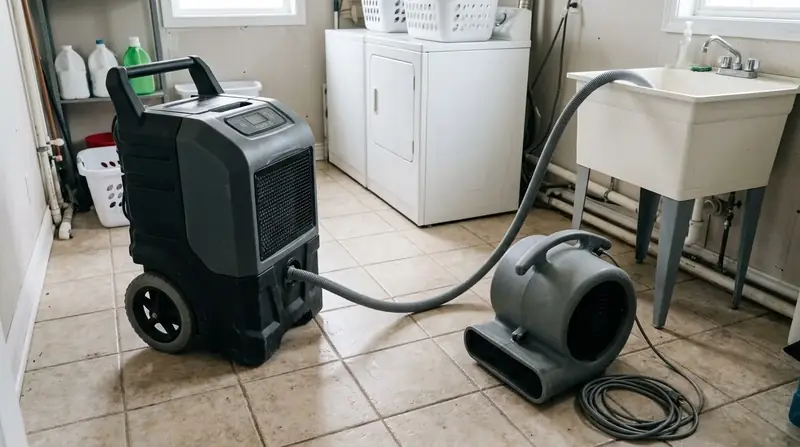
Drying equipment is commonly billed per piece, per day. That includes air movers, which are fans that blow air across wet surfaces. It also includes dehumidifiers, which pull water out of the air.
Each extra day adds to the bill. That's fair when materials are still wet. It's not fair when nobody is checking.
The fix is daily moisture readings. Ask the company to record readings each day and share them with you. The readings show why each day of equipment was needed.
How is a water damage bill priced?
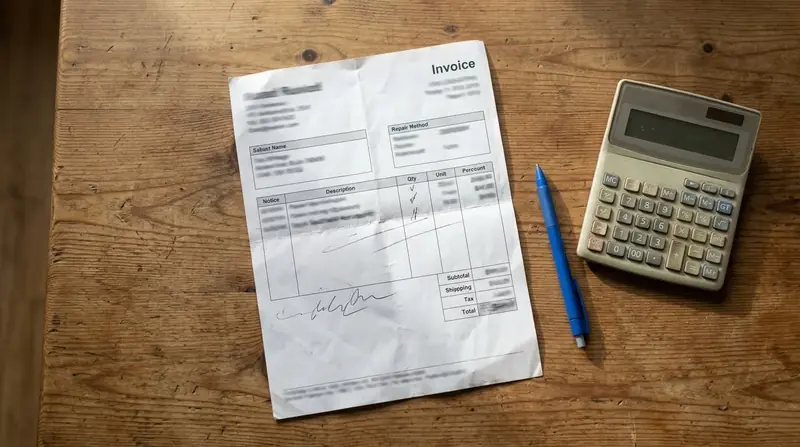
Most restoration bills are line-item estimates. Each task, material and piece of equipment gets its own line, with a quantity and a unit price.
Many of these estimates are written in Xactimate. Xactimate is property claims estimating software made by Verisk. Insurance adjusters and restoration companies often use it, so both sides may be reading the same kind of line items.
A mitigation estimate might include lines like these:
- water extraction, priced per square foot
- removing wet carpet pad, per square foot
- cutting out wet drywall, per linear foot
- each air mover or dehumidifier, per day
- antimicrobial treatment on cleaned surfaces
- daily moisture checks
Mitigation means stopping the damage: removing water and drying the building. Rebuild work, like new drywall and flooring, often comes on a separate estimate. Read both before you sign either one.
Your insurer's adjuster may write an estimate too. When the two estimates don't match, the gap is usually in the line items. Read more: mitigation bills and insurance disputes.
How much more does the rebuild add?
The rebuild can cost more than the drying. The Insurance Information Institute puts the average U.S. homeowners claim for water damage and freezing at $15,400 (2019 to 2023). It counts only insured claims, and it can include repairs and other covered costs, not just drying.
Compare that with Fixr's typical range of $1,200 to $5,000 for restoration. The difference suggests repairs can add a lot once drywall, flooring and cabinets need replacing, though the two figures measure different things. Ask whether an estimate covers drying only, or drying and repairs.
How to compare two estimates
Lay the two estimates side by side and match them line by line. Look for the same rooms, the same square footage and the same number of machines. A lower total that leaves out drywall removal or equipment days isn't really cheaper. Ask each company to explain any line the other one doesn't have.
What do real water damage bills look like?
People report mitigation quotes from under $2,000 to well over $10,000. These numbers come from posts on Reddit. They are self-reports, not checked invoices, so treat them as examples, not typical prices.
| Reported amount | What it covered | Year | Where |
|---|---|---|---|
| $1,700 quote | A mitigation plan | 2025 | post reported on Reddit |
| $2,500 quote | Drywall tear-out in 1 room, 3 days of drying in 2 rooms | 2026 | post reported on Reddit |
| $5,200 quote (Servpro) | Drying the floor under laminate after a pinhole leak | 2025 | post reported on Reddit |
| $8,500 quote | Mitigation plus demolition | 2026 | post reported on Reddit |
| $10,645 quote | Mitigation only, about 1,700 sq ft finished basement | 2026 | post reported on Reddit |
| About $15,000 quote | Mitigation, with a $2,500 deductible | 2026 | post reported on Reddit |
| $29,000 plus about $10,400 storage | Mitigation and pack-out, with 3 months of storage | 2025 | post reported on Reddit |
None of these posts came from Lancaster. They show how wide the range is, and how often people question a bill.
Is $10,645 reasonable for mitigation on 1,700 square feet?
It can be, depending on what's on the line items. As a rough check, LawnStarter's national range of $3.15 to $7.40 per square foot works out to about $5,355 to $12,580 for 1,700 square feet. A $10,645 quote falls inside that range.
To judge it, ask how many air movers and dehumidifiers are on the estimate. Ask how many days, and what readings support them. A second written estimate also helps. Doing it yourself only makes sense with clean water and a way to confirm things are dry. See can you dry water damage yourself?
Is $2,500 fair to tear out drywall and dry two rooms for 3 days?
That amount sits inside Fixr's typical national range of $1,200 to $5,000. Whether it's fair depends on the details. Check how much drywall comes out, how many machines run, and whether the price includes putting the wall back. Usually it doesn't.
What does Servpro charge, and can I copy its drying setup?
Servpro's resource page gives a national average of $3,865, with most jobs between $450 and $16,000 (September 2026). That is a national figure for water damage repair in general, not Servpro's own price list. Each company quotes its own jobs, so a local price can differ.
You can rent fans and a dehumidifier. The hard part is knowing when the wall cavity or subfloor is really dry. That takes a moisture meter and readings over several days. Water left inside a wall can lead to mold. The EPA advises drying water-damaged materials within 24 to 48 hours to prevent mold growth.
What are red flags on a water damage bill?
Watch for charges you can't match to work done, equipment days with no moisture readings, and fees no one told you about in writing.
Red flags to look for:
- Equipment billed for more days than the readings support. One person posting on Reddit reported a generator line item over $10,000. They said the generator ran for about 20 minutes (post reported on Reddit).
- Work billed that didn't happen. In a sample of Google reviews we read for Antelope Valley companies, one customer said they were billed for demolition that was never done.
- A surprise inspection fee. In the same sample, one customer described an inspection fee that wasn't in the signed paperwork.
- Lump sums with no quantities, like "drying services" with one big number.
- A final bill far above the estimate with no written change. In national reviews we read on sites like Trustpilot, this was one of the most common complaints.
- No written estimate at all before work starts.
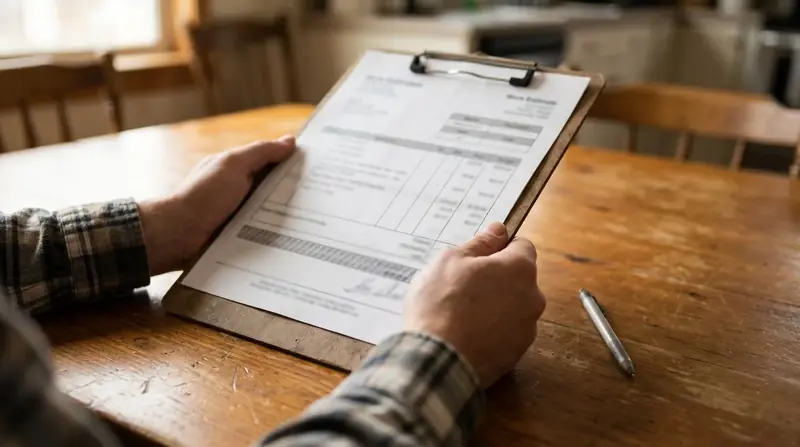
Before work begins, ask for a written estimate or scope of work. A scope of work is a list of what will be done, room by room.
How does your deductible fit in?
If insurance pays for the job, you usually pay your deductible and the insurer pays the covered amount above it. If the damage costs less than your deductible, the insurer generally isn't required to pay, the California Department of Insurance says.
For example, say your deductible is $1,000. On a covered $4,000 bill, you would usually owe the first $1,000. On an $800 bill, you would likely pay it all yourself.
The insurer may not approve every line item. On Reddit, one person reported an invoice of about $10,000 with about $6,000 approved by the insurer (post reported on Reddit). Another reported their insurer paid 57% of a toilet overflow bill (post reported on Reddit). If that happens, you may be asked to pay the gap.
Ask the company three things before work starts:
- when it collects the deductible
- whether it bills your insurer or bills you
- who pays if the insurer approves less than the bill
For small jobs, some owners skip the claim and pay directly. Read more: is a water damage claim worth filing? and water damage insurance claims in California.
Who sets the price when you call through this site?
The company you're connected with sets its own price. We don't set prices, and we don't get a say in the estimate.
When the company looks at the damage, ask for:
- a written estimate with line items
- whether there's a fee for the inspection or assessment
- how they will measure and record drying
- the company's California contractor license number
Read more: how to choose a water damage company in Lancaster, CA and how we work.
Prices by cause of damage
The cause shapes the job, and the job shapes the price. These pages explain each one:
- burst pipe water damage
- slab leak water damage
- water heater and appliance leaks
- flood damage restoration
- sewage cleanup
Get a written estimate for your home
A real price needs someone to look at the damage. Call (661) 555-0123 to be connected with a restoration company that serves your area. Calls are answered 24 hours a day, 7 days a week. Ask for a written estimate, then decide. Calling doesn't commit you to anything.
Lancaster Water Damage Restoration is a free referral service, not a contractor. When you call, you're connected with an independent restoration company that serves your area. That company sets its own prices and gives you its own written estimate. We don't set or guarantee any price.
Water in your Lancaster home right now?
Shut off the main water valve, then call. You will be connected with an independent restoration company that serves your area.
Free call · referral service, not a contractor